
THIS ARTIST HAS CONSISTANTLY BEEN A GLOBAL ICON LONG AFTER HIS DEATH
THIS ARTIST HAS CONSISTANTLY BEEN A GLOBAL ICON LONG AFTER HIS DEATH

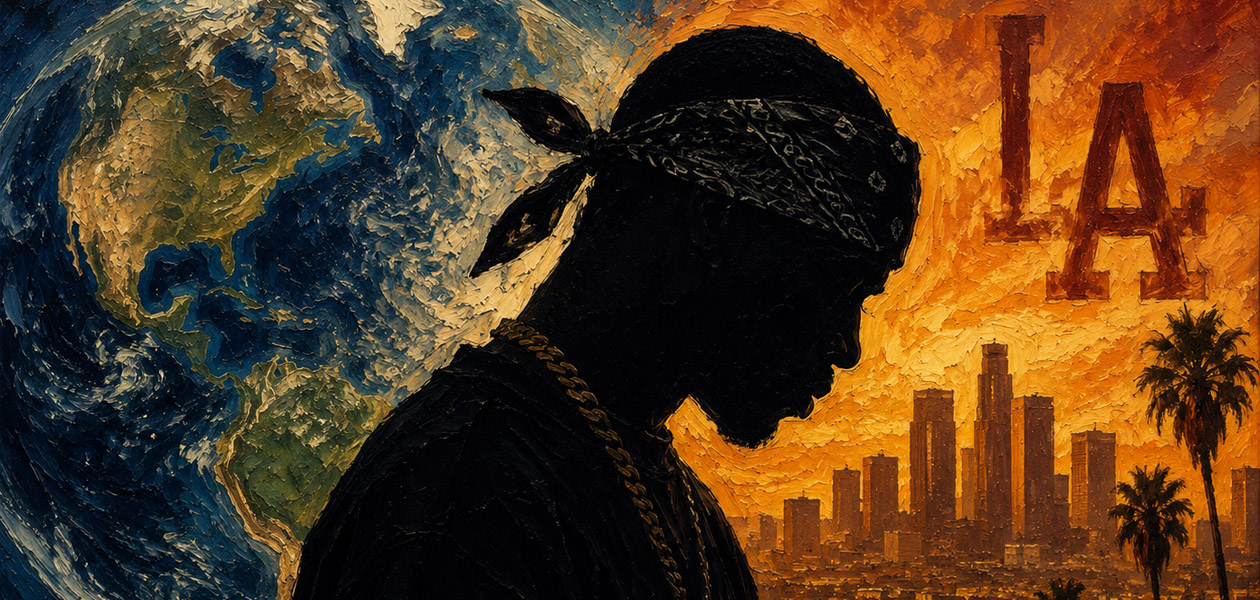
That quote, unsettling as it is, tells you everything about what Tupac Shakur became. A young man in the middle of a revolution on the North African coast, about to risk his life, reached not for a local anthem but for a rapper from Compton, California who had been dead for fifteen years. That is not the biography of a pop star. That is the biography of a symbol.
Tupac Amaru Shakur — born in East Harlem on June 16, 1971, and shot dead on September 13, 1996 — spent just five years at the center of American popular culture. In that time he released landmark albums, appeared in major films, and became rap's most magnetic and contradictory figure. But what happened after his death was something nobody in the music industry had a road map for. He didn't fade. He expanded. He went global in a way that has more in common with Che Guevara or Bob Marley than with any other figure in hip-hop history.
75M+ records sold worldwide | Age 25 at death | #1 — BET's Most Influential Rapper of All Time

So Why Him? Why Everywhere?
The question worth asking is not simply where Tupac's influence spread, but why. Academic Jeremy Prestholdt, writing in the Journal of African Cultural Studies, argued that Tupac had become a component of what he called a "planetary symbolic lingua franca" — a shared global vocabulary of dissent, pain, and resilience carried by young people who had never set foot in California. His popularity, Prestholdt wrote, was a barometer of worldwide youth alienation.
The answer lies in what Tupac actually rapped about. Poverty. Police violence. A mother struggling with addiction. Growing up in a system that seemed designed to grind you down. These are not American problems. They are human problems. His ability to render them with raw emotional precision — in songs like "Dear Mama," "Changes," and "Keep Ya Head Up" — gave listeners everywhere a mirror they could hold up to their own lives.
His artistry was also unusually wide. He could pivot from the bristling fury of "Hit 'Em Up" to the tender melancholy of "So Many Tears" without losing credibility in either register. He was a poet. He was an actor. He was, in his own words and his given name, named after an 18th-century Peruvian revolutionary. He came into the world primed to be more than entertainment.
A World Map of Devotion
Sierra Leone (West Africa) During the civil war, rebel fighters wore Tupac T-shirts as fatigues and inscribed his song titles on their weapons. Researchers described it as young men finding "broader relevance for their particular experiences."
South Africa (Southern Africa) A two-story mural of Tupac dominates an apartment block in Manenberg, Cape Town, commissioned by local residents. Bandana-wearing youth gangs adopted his iconography as identity.
Brazil (South America) Self-described "2Pacistas" emerged in the favelas of Rio and São Paulo, finding in his lyrics a direct translation of life under economic pressure and institutional neglect.
Germany & Spain (Western Europe) A statue of Tupac stands in Germany. Memorial murals appeared in Spain. European hip-hop scenes across the continent cite him as the foundational voice that proved the genre could carry moral weight.
Libya (North Africa) During the 2011 uprising against Muammar Gaddafi, rebel fighters cited Tupac as a source of defiance and courage before going into combat — a striking testament to his reach across languages and cultures.
DR Congo & Côte d'Ivoire (Central Africa) Researchers documented the use of Tupac imagery among combatants in multiple conflicts across Central and West Africa throughout the 2000s and 2010s.
The pattern across every one of these places is consistent: Tupac resonated most powerfully where inequality was sharpest and where young people felt most invisible to the systems that governed their lives. As one observer noted, in urban Africa his music became "as common as Bob Marley's once was."
The Mystery of the Martyr
Death, as uncomfortable as it is to note, accelerated the myth. Tupac was shot at 25, at the absolute peak of his powers and public profile, leaving an enormous catalogue of unreleased material that his estate continued to release for years after. The circumstances of his murder — still officially unsolved — gave rise to conspiracy theories suggesting he had faked his death, theories that only deepened the legend. He became, in the eyes of many fans, not just a dead artist but an unfinished argument.
In 2012, a digital projection of Tupac appeared on stage at the Coachella music festival alongside Snoop Dogg. The crowd's reaction — part awe, part grief, part celebration — captured perfectly the strange relationship his audience had always had with him. It felt less like a concert trick and more like a séance. The world wanted him back because the world still felt like it needed what he had to say.
The Artists Who Carry His Torch
His influence on the generation that came after him runs deep and wide. Kendrick Lamar — arguably the most critically respected rapper of his era — has consistently cited Tupac as his central inspiration, and the through-line is clear: the unflinching social critique, the narrative complexity, the willingness to be emotionally vulnerable within a genre that historically punished vulnerability. J. Cole, Drake, even artists from completely different sonic traditions have all acknowledged the debt.
But his influence has traveled far beyond the borders of hip-hop. In genres as different as Afrobeats, British grime, and Brazilian funk, the idea that popular music could be a vehicle for political consciousness — that a rapper could be a poet, an activist, and an entertainer simultaneously — owes something to the template Tupac built in five short years.
What Makes an Icon Survive?
Icons are not made by talent alone. Plenty of extraordinarily talented artists disappear from cultural memory within a generation. What makes some figures persist — what elevates them to the level of a Mandela, a Marley, a Guevara — is usually a combination of the genuineness of their conviction, the universality of what they stood for, and, often, the incompleteness of their story. Tupac had all three in abundance.
His "Thug Life" philosophy was widely misread, even at the time. It wasn't a celebration of crime — it was a survival ideology for people left behind by every social institution that was supposed to protect them. "The Hate U Give Little Infants Fucks Everybody." That was what the letters stood for. It was, at its core, a theory of systemic injustice delivered in the vernacular of the street. Thirty years later, that theory still fits the world.
"Tupac embodied the contradictions of the American dream — hope, anger, ambition, and tragedy." — The New York Times
Nearly thirty years on, the story of Tupac Shakur's global reach is ultimately a story about what people all over the world are still hungry for: an honest voice in a dishonest world. A poet who lived dangerously and died young, whose music refuses to stay in the past — because the past, in so many corners of the planet, hasn't finished happening yet.
JAZURE Magazine covers global politics, culture, and the ideas that move between borders. For more stories like this, visit jazuremagazine.com.
Related News .
Stay updated with the most important events.