
FIVE FOREIGN ELECTIONS THAT COULD AFFECT AMERICAN WALLETS IN 2026
FIVE FOREIGN ELECTIONS THAT COULD AFFECT AMERICAN WALLETS IN 2026

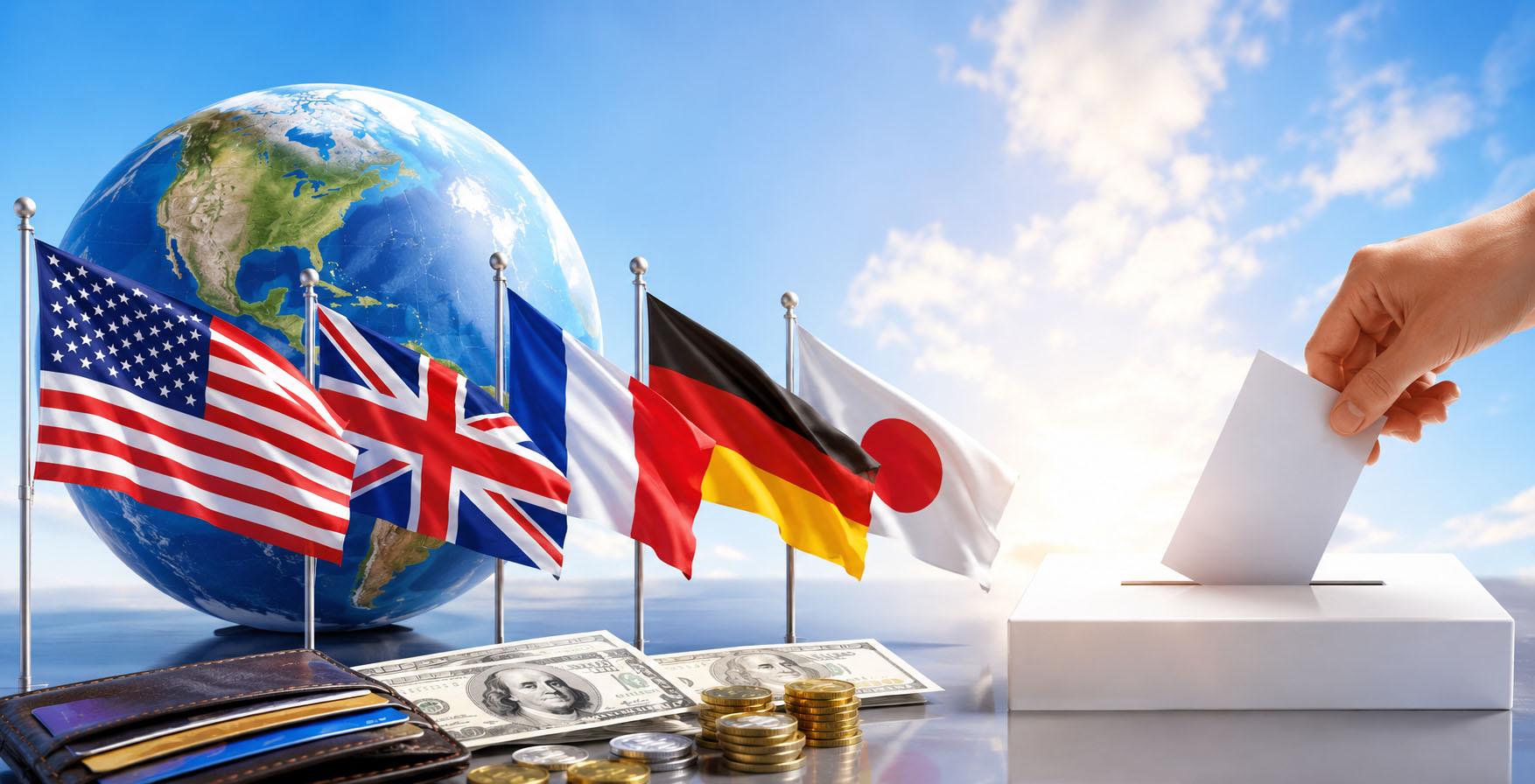
Americans tend to view foreign elections as distant spectacles — the kind of thing you might catch a two-minute segment on before the local weather. But in an era of global supply chains, tariff wars, and geopolitical tensions that can spike oil prices overnight, the outcomes of elections in Brazil, Canada, Hungary, Israel, and South Korea are shaping up to be as consequential for Main Street as anything happening in Washington. Here's a closer look at five ballots — some already counted, some still to come — and why every one of them has a dollar sign attached.
1. Brazil - General Election · October 2026
Brazil's October general election may be the most economically consequential foreign vote of the year for Americans — and it is not even close. The world's sixth-largest economy and the largest in Latin America, Brazil is a critical supplier of soybeans, oil, beef, and iron ore to global markets. When Brazil's political winds shift, commodity prices — and the cost of the food on your table — can feel it.
The race is shaping up as a rematch between President Luiz Inácio Lula da Silva and a right-wing challenger, with São Paulo Governor Tarcísio de Freitas and Senator Flávio Bolsonaro both circling as potential standard-bearers for the opposition. Analysts at SEB have flagged that the October contest is already "set to dominate Brazil's political and market dynamics," with uncertainty driving asset price volatility ahead of polling day. Brazil's public debt is racing toward 95 percent of GDP, and growth has slowed to a projected 1.8 percent for the year — a shaky fiscal platform heading into one of the most consequential electoral cycles the country has seen in a decade.
For American consumers, the stakes hinge on a single geopolitical fault line: which direction does a post-election Brazil tilt — toward Washington or toward Beijing? Analysts at Portfolio Adviser put it plainly: a Lula victory would likely accelerate closer ties with China, potentially deepening supply-chain relationships between the two nations and reshaping commodity flows. A victory for a Bolsonaro-aligned candidate would probably see Brazil return to a more balanced posture. Either outcome reshapes who controls the flow of the critical minerals and agricultural goods that underpin American manufacturing and grocery costs alike.
"The extent and pace of Brazil's shift will largely depend on its leadership after the next presidential elections." — SEB Chief Emerging Markets Strategist Erik Meyersson**
There is also a trade dimension that directly touches American exporters. The U.S. and Brazil have been in a "cold peace," with tariff tensions complicating a potential bilateral trade deal covering critical minerals — deposits of which account for roughly 20 percent of global reserves. Whether the next Brazilian president comes to the table as a partner or a rival will determine whether American companies get access to those resources or watch China deepen its foothold in the Amazon's economic future.
2. Canada - Federal Election · April 2025 · Consequences Still Unfolding
Canada's April 2025 federal election may have technically happened last year, but its economic consequences for Americans are only now coming into full relief — and they are significant. When Liberal leader Mark Carney, a former governor of both the Bank of Canada and the Bank of England, swept to power on a wave of anti-Trump sentiment, he did so with a mandate to push back against U.S. tariff aggression. The result: a trade relationship that was once North America's most seamlessly integrated is now being actively and deliberately rewired.
Carney came to office promising retaliatory tariffs on American goods and pledged to build an economy less dependent on its southern neighbor. In his victory speech, he said plainly that "the old relationship with the United States — a relationship based on steadily increasing integration — is over." That is not rhetorical flourish; it is policy. American exporters who relied on Canadian consumers as their easiest foreign market are now confronting new friction, new levies, and a Canadian government that is actively courting alternative trade partners in Europe and Asia.
For ordinary Americans, the pinch comes in places you might not expect. Canada is the single largest foreign supplier of oil and natural gas to the United States. It is also a top source of aluminum, lumber, potash (which fertilizes American crops), and softwood used in home construction. When the bilateral relationship cools and retaliatory measures build, prices for gasoline, building materials, and food production inputs can all climb. According to the Council on Foreign Relations, the political shockwaves of Trump's tariff posture triggered a historic reversal in Canadian electoral politics — and the economic aftershocks now flow both ways across the border.
3. Hungary - Parliamentary Election · April 12, 2026
When Péter Magyar's Tisza party swept Viktor Orbán from power in Hungary's April 12 parliamentary elections — ending his sixteen-year grip on the country — the cheers that rang out from Brussels to Berlin also reverberated through financial markets. The Hungarian forint hit a four-year high and 10-year government bond yields fell sharply on the morning after the vote. For Americans, that market response matters because it signaled something larger: the European Union now has one fewer wrench in its gears, and a more coherent EU means a more stable economic partner for the United States.
Orbán's Hungary had spent years acting as a blocker inside the European Union — stalling energy sanctions on Russia, obstructing aid packages for Ukraine, and holding up cohesion funding in ways that created internal EU friction. That friction had economic costs that rippled outward, contributing to energy price instability across the continent and slowing the EU's ability to act collectively on trade. A less gridlocked EU is better positioned to finalize major trade arrangements, including long-delayed discussions that affect American firms operating in European markets.
"Orbán had become a guiding star of far-right politics across Europe. Now that Tisza's political wave has arrived, the transatlantic alliance looks meaningfully different." — Atlantic Council
Magyar has signaled that his government will prioritize relocking Hungary's access to frozen EU structural funds — potentially unlocking billions of euros in economic stimulus that could boost European consumer demand, including for American-made goods. He has also pledged to restore Hungary as what he called "a valued and constructive ally" within NATO. A more cohesive NATO alliance ultimately reduces the ambiguity — and the defense spending uncertainty — that keeps American taxpayers subsidizing European security at disproportionate rates. The downstream budget effects may be modest, but the directional shift matters enormously for long-term U.S. fiscal planning.
4. Israel - Knesset Election · By October 27, 2026
Israel's upcoming Knesset elections — required to be held no later than October 27 — arrive at one of the most geopolitically loaded moments in the country's modern history. Coming in the wake of the October 7 Hamas attack, the Gaza war, the conflict with Hezbollah, and the 2026 Israeli-U.S. strikes on Iran, the vote is effectively a referendum on Benjamin Netanyahu's leadership and on what kind of state Israel intends to be in its aftermath. For Americans, the consequences run straight through the gas pump.
The Middle East remains the world's most sensitive energy flashpoint, and Israel's election will shape the region's trajectory for years. The Iran conflict that accompanied Netanyahu's current term sent oil prices soaring — a fact that Britannica's analysis of the 2026 U.S. midterm landscape explicitly noted as a complicating economic variable for American households. If the incoming Israeli government takes a harder or softer line on Iran, on Gaza's future governance, or on relations with Gulf states, those choices will ripple through global oil markets and affect what Americans pay at the pump.
Beyond energy, there is the question of U.S. foreign aid and defense expenditure. The United States provides Israel with billions of dollars in annual military assistance, and the policy framework that governs that relationship — how much, under what conditions, and for what purposes — is directly tied to who leads Israel and what coalition they assemble. A far-right coalition doubling down on settlement expansion in the West Bank could trigger international sanctions or boycotts that complicate American business interests in the region. A centrist or center-left government might reopen diplomatic pathways that stabilize markets. The financial stakes of the Knesset vote extend well beyond the Jordan River.
5. South Korea - Snap Presidential Election · June 3, 2025 · Consequences Deepening in 2026
Like Canada's election, South Korea's snap presidential vote in June 2025 officially falls just outside 2026 — but its economic consequences for Americans are accelerating, not fading. When Lee Jae-myung of the progressive Democratic Party was elected president after the impeachment and removal of Yoon Suk Yeol, he inherited not just a country in political crisis but a set of high-stakes tariff negotiations with Washington that remain unresolved as of mid-2026.
South Korea is one of America's most consequential trading partners. It is the home of Samsung, LG, Hyundai, and Kia — brands that Americans buy, drive, and depend on every day. Major Korean conglomerates have already pledged tens of billions of dollars in new U.S. investments in response to Trump's tariff pressures, with Hyundai alone committing up to $21 billion over three years. How the Lee government navigates the ongoing 25 percent U.S. tariff on Korean steel, aluminum, and automobiles will directly determine whether those investment pledges hold — and whether those factories get built on American soil.
Lee pledged "pragmatic diplomacy" and called the U.S.-Korea alliance "the foundation of South Korea's foreign policy" — but the tariff negotiations remain unresolved and consequential for both sides.
There is also a semiconductor dimension that touches every American with a smartphone, laptop, or modern vehicle. South Korea, alongside Taiwan, anchors global chip production. The stability of the Lee government — and its ability to manage both the geopolitical pressure from Beijing and the trade pressure from Washington — determines whether the chip supply chains that power American technology remain predictable or grow volatile. In an era when semiconductor shortages can stall car production and drive up consumer electronics prices, the political health of Seoul is not an abstraction. It shows up in your monthly budget.
The through-line connecting all five of these elections is a simple truth that globalization has made undeniable: democracy is not a local event. When Brazilians choose between a leftist who tilts toward China and a conservative who leans toward Washington, they are also choosing who gets access to the minerals that could power American electric vehicles. When Canadians elected a prime minister who campaigned on economic independence from the United States, they were reshaping the terms under which Americans heat their homes. When Hungarians voted out an autocrat who blocked EU unity, they eased a friction point that had quietly inflated costs for American companies operating in Europe. When Israelis and South Koreans choose their next leaders, they are setting the terms of alliances that carry enormous budgetary and market consequences for the United States.
None of this means Americans should feel helpless. Understanding these dynamics — tracking who wins, what they promise, and what geopolitical posture they adopt — is itself a form of economic literacy. Whether you are an investor watching emerging market exposure, a small business owner reliant on imported goods, or a consumer trying to make sense of why prices keep moving, the ballot box abroad is one of the most underrated factors in your financial life.
In 2026, the world is voting. And Americans will feel the results whether they are paying attention or not.
JAZURE Magazine covers global politics, culture, and the ideas that move between borders.
Related News .
Stay updated with the most important events.